
Last Updated: July 2026 | Reading Time: 15 Minutes | Reviewed by: Affiliate Partnership Team
Quick Answer
An affiliate network connects advertisers with publishers and manages tracking, reporting, and commission payments. A publisher platform helps publishers discover, manage, and optimise campaigns from one place—often by working with one or multiple affiliate networks behind the scenes. Although the two work closely together, they serve different purposes.
When new publishers enter affiliate marketing, one of the most common questions they ask is:
“Is an affiliate network the same thing as a publisher platform?”
It’s a fair question because many websites, YouTube videos, and even industry articles use both terms interchangeably. That confusion often leads beginners to join the wrong platform, misunderstand how commissions are tracked, or spend weeks trying to manage campaigns that could have been organised much more efficiently.
I still remember speaking with a publisher who had signed up for several affiliate programmes individually because he believed that was the only way to work with brands. He had separate dashboards, different payment schedules, multiple reporting systems, and countless tracking links saved in spreadsheets. Every month he spent more time organising accounts than creating content.
Once he understood how affiliate networks and publisher platforms actually fit together, everything changed. Instead of juggling dozens of independent relationships, he could focus on what really mattered—creating quality content, growing traffic, and improving conversions.
That conversation inspired this guide.
Rather than giving you another generic definition copied from marketing websites, this article explains how these platforms work in the real world, how experienced publishers use them together, and how to decide which option fits your business.
Table of Contents
What Is an Affiliate Network?
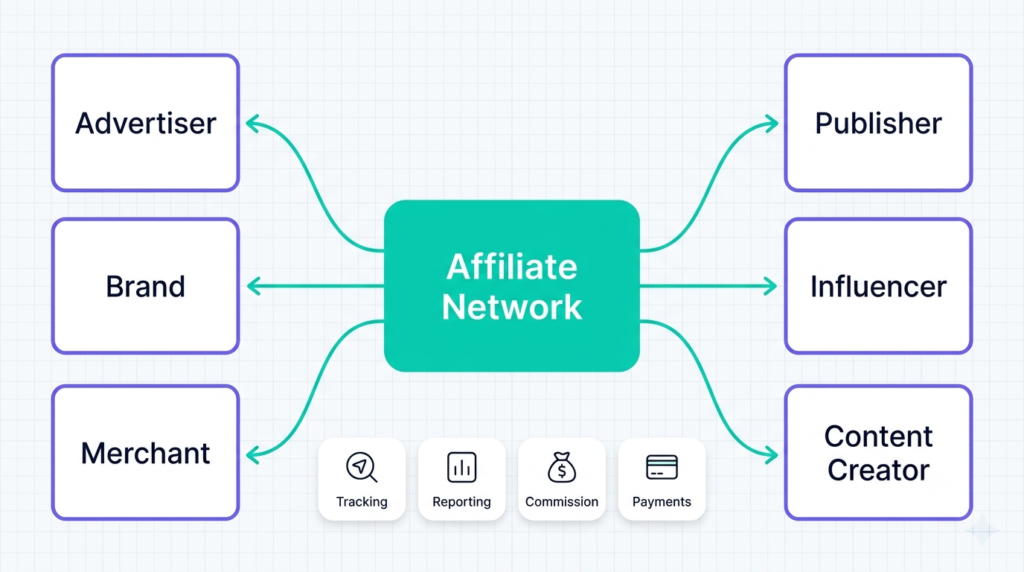
An affiliate network is a technology platform that connects two groups:
- Businesses that want more customers (Advertisers)
- People who promote products and services (Publishers)
Instead of every advertiser building its own tracking software, payment system, reporting dashboard, and publisher management process, an affiliate network provides all of those services in one place.
Think of an affiliate network as the infrastructure behind an affiliate programme. It tracks clicks, records conversions, calculates commissions, detects suspicious activity, and processes payments according to the advertiser’s rules.
Without affiliate networks, publishers would often need separate systems for every advertiser they wanted to promote.
Example
Imagine you want to promote software, fashion products, travel services, and web hosting.
Without an affiliate network, you might have to create separate accounts for every individual brand.
With an affiliate network, many of those advertisers can be accessed through one dashboard, using the same reporting interface and payment process.
Most established affiliate networks provide:
- Campaign management
- Tracking technology
- Conversion reporting
- Commission management
- Payment processing
- Fraud detection
- Publisher approval systems
- Performance analytics
Popular examples include platforms such as CJ Affiliate, Awin, Impact, ShareASale, PartnerStack, Rakuten Advertising, and ClickBank, each serving different industries and publisher types.
Although every network has its own interface and approval process, their core responsibility remains the same: accurately tracking performance between advertisers and publishers.
What Is a Publisher Platform?
While an affiliate network focuses on connecting advertisers with publishers and handling tracking, a publisher platform is designed to help publishers manage their affiliate marketing activities more efficiently. Instead of spending time logging into multiple dashboards, searching for suitable campaigns, organising tracking links, and monitoring performance across different systems, a publisher platform brings these activities together into a single workspace. In simple terms, an affiliate network primarily serves the relationship between advertisers and publishers, whereas a publisher platform focuses on improving the publisher’s day-to-day workflow.Imagine you’re a content creator working with dozens of brands.
Without a publisher platform you might need to:- Log into five or six different affiliate networks.
- Search each dashboard individually for campaigns.
- Remember different payment schedules.
- Track separate reports.
- Store hundreds of affiliate links manually.
- Help publishers discover relevant campaigns.
- Simplify campaign management.
- Reduce administrative work.
- Improve reporting visibility.
- Provide a better publishing experience.
Affiliate Network vs Publisher Platform
Although both are part of the affiliate marketing ecosystem, they solve different problems. The easiest way to understand the difference is by comparing what each platform is actually built to do.| Feature | Affiliate Network | Publisher Platform |
|---|---|---|
| Main Purpose | Connect advertisers with publishers | Help publishers manage campaigns more efficiently |
| Primary Users | Advertisers and Publishers | Publishers, Influencers and Content Creators |
| Tracking Technology | Yes | Usually integrated or connected |
| Campaign Discovery | Available | Often simplified and organised |
| Commission Payments | Processed by the network | Depends on platform structure |
| Best For | Managing advertiser relationships | Managing publishing activities |
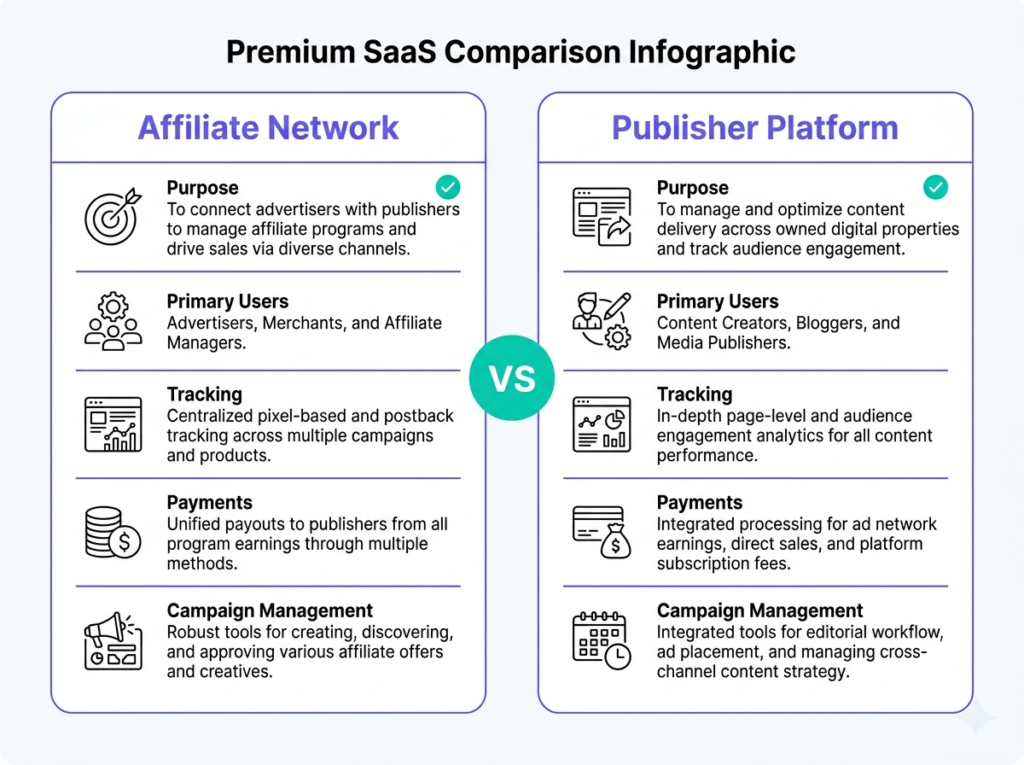
Neither option is “better” than the other because they aren’t direct competitors.
Instead, they often work together to create a smoother experience for publishers, advertisers, agencies, and creators.
Important Takeaway
Many beginners think they have to choose between an affiliate network and a publisher platform.
In reality, publishers frequently use both.
The affiliate network provides the infrastructure for tracking and commission management, while the publisher platform focuses on helping publishers organise, discover, and optimise their campaigns.
How Affiliate Networks Actually Work
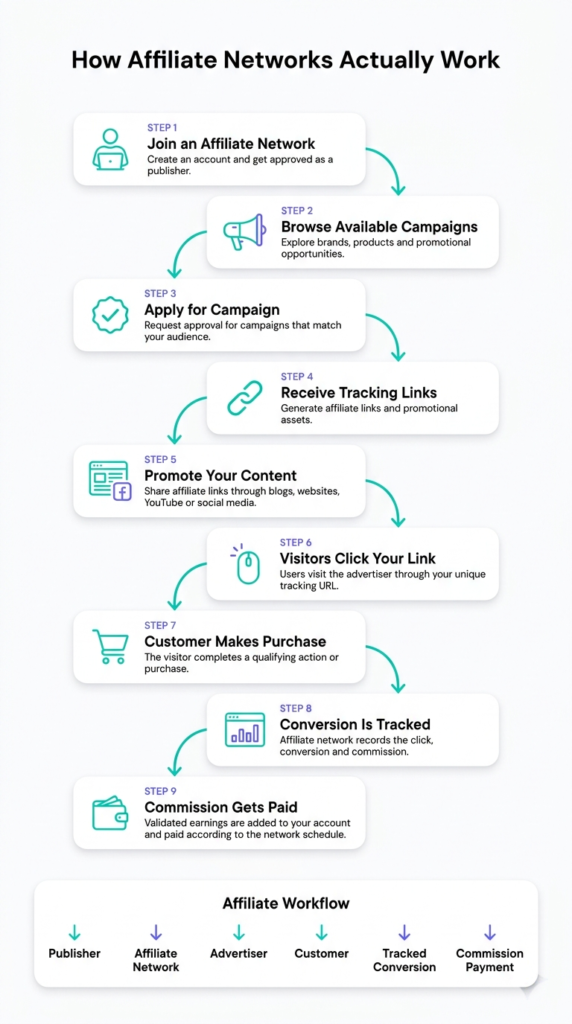
Understanding how an affiliate network works is much easier once you see the complete process from start to finish. While every platform has its own interface, the overall workflow is remarkably similar across the industry.
At its core, an affiliate network acts as the technology layer that connects advertisers with publishers. It manages campaign listings, generates tracking links, records clicks and conversions, calculates commissions, and processes publisher payments—all from a single platform.
Instead of building separate relationships with dozens of brands, publishers can discover and manage multiple affiliate programs through one centralized dashboard. Likewise, advertisers gain access to thousands of publishers without having to build and maintain their own affiliate infrastructure.
Step-by-Step Affiliate Network Workflow
- Create a Publisher Account
The journey begins by registering as a publisher. Most affiliate networks review applications before granting access, although approval requirements vary from one platform to another.
- Browse Available Campaigns
After approval, publishers can search hundreds or even thousands of campaigns using filters such as industry, country, commission type, payout rate, or advertiser.
- Apply to Individual Advertisers
Joining the network does not automatically provide access to every advertiser. Many brands manually review publisher applications to ensure the website, audience, and traffic quality align with their marketing objectives.
- Generate Affiliate Tracking Links
Once approved, publishers receive unique tracking links, banners, promotional assets, and sometimes exclusive coupon codes. These tracking links allow every click and sale to be attributed to the correct publisher.
- Promote the Campaign
Publishers can share affiliate links through blog articles, product reviews, comparison pages, email newsletters, YouTube videos, Pinterest, social media, or other approved traffic sources.
- Track Clicks and Conversions
Every visitor who clicks an affiliate link is recorded by the network’s tracking system. If the visitor completes the advertiser’s required action—such as making a purchase, signing up, or submitting a lead—the commission is automatically credited to the publisher.
- Receive Payments
Once commissions are approved and payment thresholds are reached, publishers receive payouts according to the network’s payment schedule. Most professional affiliate networks provide transparent reporting, earnings history, and payment tracking inside the publisher dashboard.
Why Affiliate Networks Simplify the Entire Process
Without an affiliate network, publishers would need to create separate accounts for every advertiser, learn different reporting systems, manage multiple payment schedules, and manually organize tracking links across dozens of programs.
An affiliate network removes much of that complexity by centralizing campaign discovery, reporting, tracking, commission management, and payments into one platform. This allows publishers to spend more time creating content and less time managing administrative tasks.
Real-world tip: Experienced affiliate marketers rarely judge a network solely by its commission rates. Reliable tracking, accurate reporting, quality advertisers, and consistent payments usually have a much bigger impact on long-term earnings.
Affiliate Networks vs. Individual Affiliate Programs
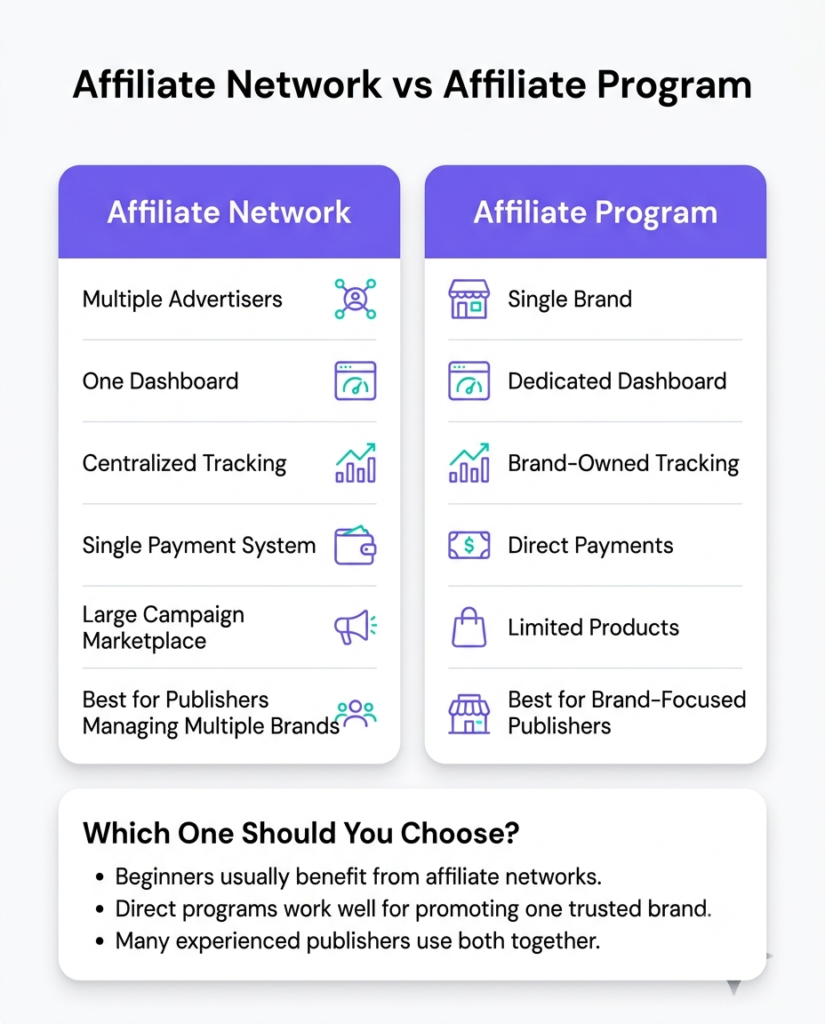
Key Differences at a Glance
| Feature | Affiliate Network | Affiliate Program |
|---|---|---|
| Number of Advertisers | Multiple brands | Single company |
| Dashboard | One dashboard for many campaigns | Separate dashboard for one brand |
| Tracking | Centralized tracking system | Managed by the individual company |
| Payments | One payment covering multiple advertisers | Paid directly by the company |
| Campaign Variety | Very High | Limited to one business |
| Best For | Publishers managing multiple partnerships | People promoting a specific brand |
When Should You Join an Affiliate Program?
Direct affiliate programs make sense when you’re already committed to promoting one particular brand. Many established companies run their own in-house programs because they want complete control over their partnerships, commissions, and reporting. If your website focuses heavily on one product category—for example, website hosting, email marketing software, or a favourite SaaS platform—a direct affiliate program may offer slightly higher commission rates and closer communication with the brand.When Should You Use an Affiliate Network?
Most publishers eventually reach a point where managing dozens of individual accounts becomes difficult. Logging into multiple dashboards, checking different payment schedules, downloading reports, and keeping track of various campaigns quickly becomes time-consuming. This is where affiliate networks become valuable. They simplify campaign discovery, consolidate reporting, and reduce administrative work, allowing publishers to spend more time creating content instead of managing accounts.Practical Tip: Many experienced affiliate marketers use both. They join direct affiliate programs for brands they strongly recommend while using affiliate networks to discover new campaigns and diversify their income.
Which Option Is Better for Beginners?
If you’re completely new to affiliate marketing, starting with a reputable affiliate network is often the easiest path. You’ll gain access to multiple advertisers, learn how campaign approvals work, and become familiar with tracking reports without creating dozens of separate accounts. As your website grows and your audience becomes more focused, you can gradually add direct affiliate programs that offer better commissions or exclusive partnership opportunities.Best Affiliate Networks (And What Each Is Actually Good For
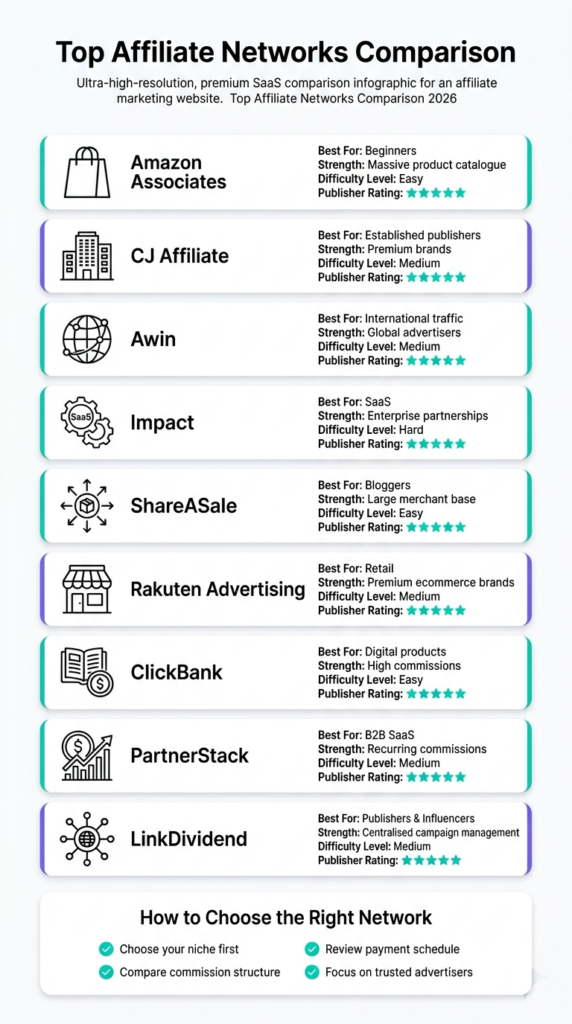
One of the most common questions new publishers ask is, “Which affiliate network should I join first?” The honest answer is that there isn’t one network that’s perfect for everyone. The right choice depends on your niche, traffic source, target audience, and the type of products you plan to promote.
Over the years, the affiliate marketing industry has grown far beyond simple retail commissions. Today, some platforms specialise in physical products, others focus on SaaS software, while some are designed for influencers, agencies, or content publishers managing hundreds of campaigns.
Rather than looking for the “highest paying” network, it’s usually better to choose one that fits your content strategy and audience. A slightly lower commission on products your visitors actually buy will almost always outperform a higher commission on products nobody wants.
Top Affiliate Networks Worth Considering
Amazon Associates
Best For: Beginners, bloggers, review websites, product recommendation content.
Amazon Associates remains one of the easiest places to start because almost everyone already shops on Amazon. Approval is straightforward, the product catalogue is enormous, and nearly every niche can find relevant products to recommend. Although commission percentages are relatively low, the high conversion rate often makes up for it.
CJ Affiliate
Best For: Established publishers and content websites.
CJ Affiliate (formerly Commission Junction) is one of the oldest affiliate networks in the industry. It partners with thousands of recognised brands across retail, finance, travel, education, and technology. Publishers who already receive consistent traffic usually benefit the most from CJ’s wide campaign selection.
Awin
Best For: International publishers and global audiences.
Awin has built one of the world’s largest affiliate marketplaces with advertisers across Europe, North America, Asia, and Australia. If your website attracts visitors from multiple countries, Awin provides access to a diverse range of campaigns and payment options.
Impact
Best For: SaaS, software companies, premium brands and enterprise partnerships.
Impact focuses heavily on technology, software, subscription services, and large enterprise advertisers. Many high-ticket SaaS affiliate programs operate through Impact because of its advanced tracking, automation, and partnership management features.
ShareASale
Best For: Lifestyle websites, bloggers and niche publishers.
ShareASale offers thousands of merchants across fashion, home improvement, business software, online services, and digital products. Its interface is beginner-friendly while still providing enough reporting tools for experienced publishers.
Rakuten Advertising
Best For: Retail publishers and premium ecommerce brands.
Rakuten works with many globally recognised retailers and premium consumer brands. While approval standards may be stricter than some other networks, publishers with quality content often gain access to exclusive campaigns unavailable elsewhere.
ClickBank
Best For: Digital products, online courses, ebooks and software.
ClickBank is well known for offering high commission percentages because many products are digital. Publishers should always evaluate product quality before promoting anything, as conversion rates depend heavily on trust and relevance.
PartnerStack
Best For: SaaS affiliates, B2B publishers and agencies.
PartnerStack specialises in recurring commission software partnerships. Many well-known SaaS companies use PartnerStack to manage their affiliate and partner programs, making it attractive for publishers targeting entrepreneurs, marketers, and business owners.
LinkDividend
Best For: Publishers, influencers and agencies looking for a centralised campaign management platform.
Instead of operating as a traditional affiliate network, LinkDividend helps publishers discover campaigns from trusted affiliate network partners through one streamlined dashboard. Publishers can manage approvals, tracking, reporting, and payments more efficiently without constantly switching between multiple platforms.
How Should You Choose the Right Network?
Before creating accounts everywhere, ask yourself these questions:
- Does this network have advertisers that match my niche?
- Are the commission rates competitive for my industry?
- Does it support the countries where my visitors live?
- How reliable is the tracking and reporting?
- What is the minimum payout threshold?
- How often are commissions paid?
- Does the network have a good reputation among publishers?
Author’s Insight: Many experienced publishers eventually use more than one affiliate network. Instead of relying on a single source of income, they combine different networks to access more advertisers, increase earning opportunities, and reduce risk if one program changes its commission structure.
Common Mistakes People Make With Affiliate Networks
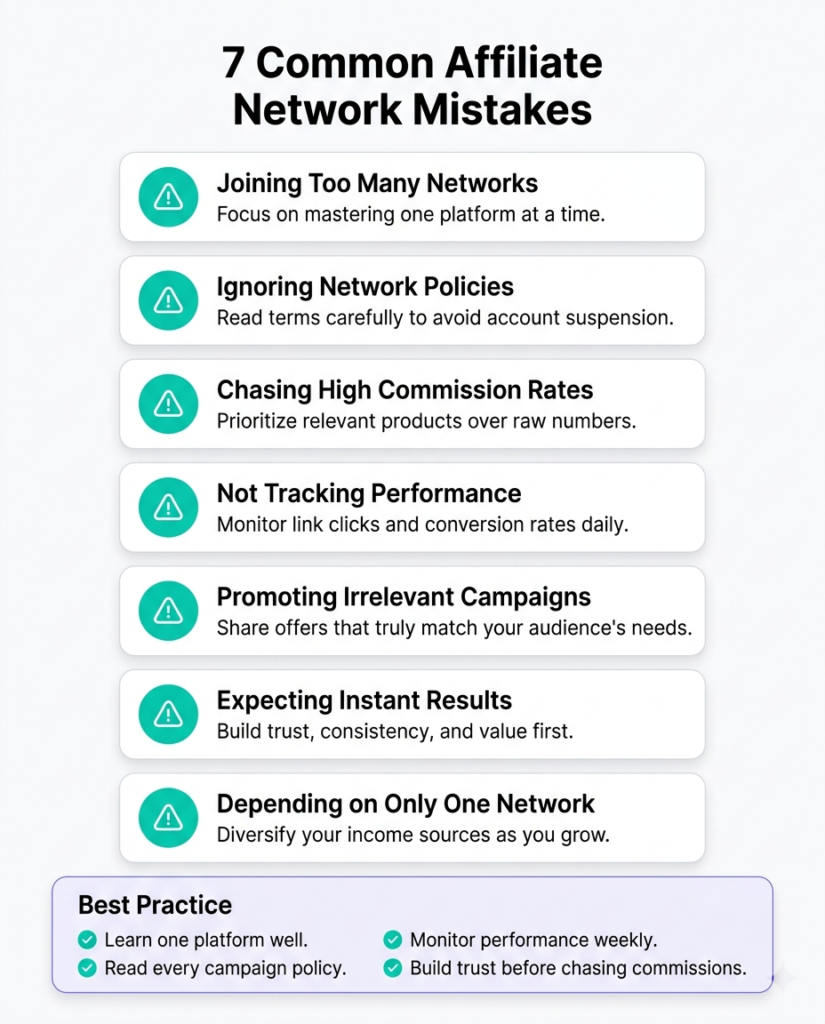
One thing I’ve noticed after speaking with new publishers is that most affiliate marketing failures aren’t caused by choosing the wrong network. They’re usually caused by avoidable mistakes made during the first few months.
Affiliate networks provide the tools, campaigns, and tracking systems—but success still depends on how publishers use them. Understanding these common mistakes early can save you months of frustration and help you build a much stronger foundation.
1. Joining Too Many Networks Too Early
It might seem like joining every affiliate network increases your earning potential, but the opposite often happens. Managing multiple dashboards, different approval processes, payment schedules, and reporting systems quickly becomes overwhelming.
Instead of trying to learn five different platforms at once, focus on mastering one or two networks first. Once you’re comfortable with campaign management and reporting, expanding becomes much easier.
Pro Tip:
Quality partnerships almost always outperform quantity. It’s better to actively promote ten relevant campaigns than passively join one hundred.
2. Ignoring the Network’s Terms and Policies
Every affiliate network has its own policies regarding promotional methods, paid advertising, email marketing, incentive traffic, trademark bidding, and social media promotion. Many beginners skip reading these rules completely.
Violating network policies—even accidentally—can result in rejected commissions, suspended campaigns, or even permanent account closure.
Always review:
- Traffic source restrictions
- Paid advertising policies
- Email marketing rules
- Social media guidelines
- Trademark bidding policies
- Coupon and cashback restrictions
3. Chasing High Commission Rates Instead of High Conversions
Many beginners automatically choose campaigns offering the highest commission percentage. While higher payouts look attractive, they don’t always generate the most revenue.
A product with a 40% commission but very low conversion rate may earn far less than a trusted product paying only 8% commission but converting consistently.
Successful publishers focus on products their audience genuinely wants instead of chasing the biggest percentage.
4. Not Tracking Performance Properly
One of the biggest advantages of affiliate networks is detailed reporting. Unfortunately, many new publishers rarely open their analytics dashboard after generating affiliate links.
Without analysing clicks, conversions, EPC (Earnings Per Click), approval rates, and top-performing campaigns, it’s impossible to know what’s actually working.
Review your reports regularly and optimise based on real performance data—not assumptions.
5. Promoting Irrelevant Campaigns
Not every campaign fits every audience.
For example, promoting business accounting software on a fashion blog—or skincare products on a technology website—usually produces poor results regardless of commission rates.
Your audience should always come before the commission.
Relevant recommendations build trust, improve click-through rates, and lead to more conversions over time.
6. Expecting Instant Results
Affiliate marketing is often presented online as a quick way to earn passive income. In reality, successful publishers spend months creating helpful content, building trust, improving SEO, and learning what resonates with their audience.
Most publishers don’t earn significant commissions during their first few weeks. Consistency is usually the biggest difference between publishers who succeed and those who quit too early.
7. Relying on Only One Affiliate Network
Putting all your income into one affiliate network creates unnecessary risk. Commission structures change, advertisers leave networks, campaigns close, and payment terms evolve over time.
Diversifying across several trusted platforms provides greater long-term stability while giving you access to a wider range of advertisers.
Quick Checklist Before Joining Any Affiliate Network
- ✓ Read the network’s publisher policies.
- ✓ Verify payment methods and payout thresholds.
- ✓ Choose campaigns relevant to your audience.
- ✓ Monitor reporting dashboards regularly.
- ✓ Focus on long-term trust instead of quick commissions.
- ✓ Diversify income gradually as your website grows.
Author’s Insight: Looking back, my biggest mistake wasn’t choosing the wrong affiliate network—it was assuming every campaign would perform equally well. Once I started analysing reports instead of guessing, I stopped wasting time on low-performing offers and focused on campaigns my audience genuinely valued.
Actionable Best Practices for Long-Term Affiliate Success
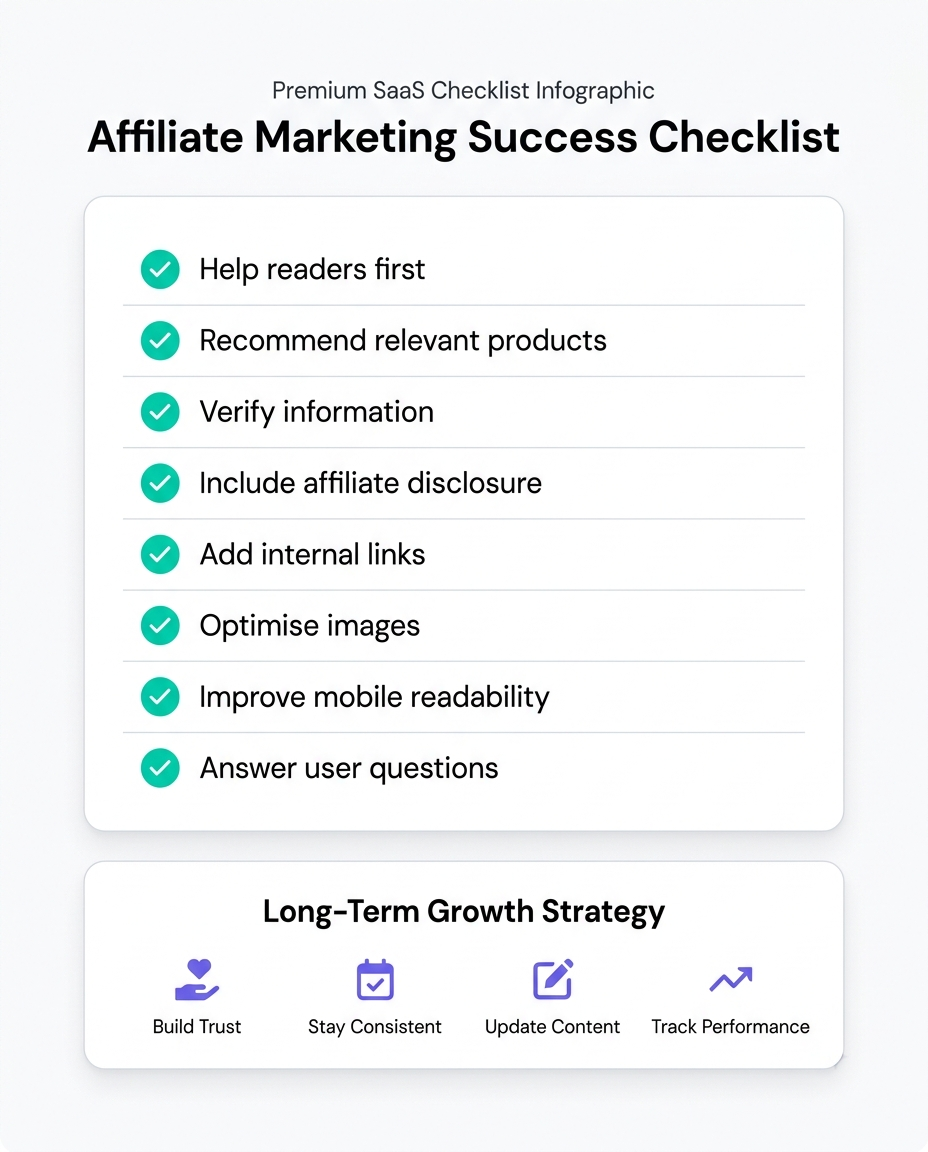
By this point, you understand what affiliate networks are, how they work, and the mistakes that often prevent publishers from earning consistent commissions. The next step is developing habits that help you grow steadily over time.
Successful affiliate marketing isn’t built on shortcuts or luck. It’s built on trust, consistency, continuous learning, and making decisions based on real performance data instead of assumptions.
1. Prioritize Your Audience Before Commissions
The highest-paying offer isn’t always the best choice. If a product doesn’t genuinely help your audience, promoting it can damage trust and reduce long-term conversions.
Every recommendation should answer one simple question:
“Would I still recommend this if there were no commission involved?”
If the answer is yes, you’re building a sustainable affiliate business.
2. Build Topical Authority Instead of Random Content
Search engines increasingly reward websites that demonstrate expertise within a specific topic. Instead of publishing unrelated articles, create content clusters around your niche.
For example, an affiliate marketing website might publish articles covering:
- Affiliate Networks
- Affiliate Programs
- Commission Models
- Publisher Guides
- Tracking & Attribution
- Influencer Marketing
- Affiliate SEO
- Performance Marketing Trends
Connecting these articles through internal links helps search engines understand your expertise while making it easier for visitors to explore related topics.
3. Monitor Performance and Optimise Regularly
Publishing an article is only the beginning. High-performing publishers continually improve their content using real data.
Review your analytics every month and ask:
- Which pages receive the most traffic?
- Which affiliate links generate the most clicks?
- Which campaigns convert the best?
- Which articles need updating?
- Which keywords are gaining visibility?
Small improvements made consistently often produce better long-term results than constantly creating new content.
4. Keep Your Content Updated
Affiliate marketing changes quickly. Commission rates, advertiser policies, tracking technology, and available programs evolve every year.
Refreshing your articles regularly helps maintain search rankings while ensuring visitors receive accurate information.
Update articles whenever:
- New affiliate platforms emerge.
- Industry trends change.
- Tracking technology evolves.
- Major advertisers change their programs.
- Google updates its search guidance.
5. Diversify Your Traffic Sources
Relying entirely on one traffic source creates unnecessary risk.
Most successful publishers gradually build audiences across multiple channels, including:
- Organic Search (SEO)
- YouTube
- Email Newsletters
- Facebook Communities
- TikTok (where relevant)
Multiple traffic sources create greater stability if one platform experiences significant algorithm changes.
6. Think Like a Business Owner
Affiliate marketing isn’t just about generating links. It’s about building an online business that continues growing over time.
Professional publishers focus on:
- Helping readers solve real problems.
- Building authority in one niche.
- Creating evergreen content.
- Improving user experience.
- Maintaining transparency and trust.
- Following ethical marketing practices.
Those principles remain valuable regardless of how technology or search engines evolve.
Your Affiliate Success Checklist
Before Publishing Any Affiliate Content
- ✓ Does this article genuinely help readers?
- ✓ Is every recommendation relevant?
- ✓ Have I verified the information?
- ✓ Are affiliate disclosures clearly included?
- ✓ Have I added useful internal links?
- ✓ Have I optimised images for SEO?
- ✓ Is the content easy to read on mobile?
- ✓ Have I answered common user questions?
Author’s Insight: The biggest lesson I’ve learned is that affiliate marketing rewards patience far more than shortcuts. Every helpful article, every improved page, and every small optimisation builds momentum. Consistent publishers rarely see overnight success—but they often achieve results that last for years.
Frequently Asked Questions (People Also Ask)
Below are some of the most common questions people ask when learning about affiliate networks and affiliate marketing. If you’re just getting started, these answers should help clear up many of the misconceptions beginners often have.What is an affiliate network?
An affiliate network is a platform that connects advertisers with publishers. Instead of applying to dozens of companies individually, publishers can access multiple affiliate programs through one dashboard. The network manages tracking, reporting, commission calculations, and payments, making it much easier to manage multiple partnerships. Examples include CJ Affiliate, Awin, ShareASale, Impact, and PartnerStack. Some publisher platforms also help simplify campaign management by bringing together offers from multiple affiliate network partners.What’s the difference between an affiliate network and an affiliate program?
An affiliate program belongs to a single company, while an affiliate network provides access to campaigns from many different advertisers. If you join an affiliate program, you’re working directly with one business. If you join an affiliate network, you’re using a platform that manages multiple advertisers, reporting systems, and payment processes in one place. Many experienced publishers use both depending on the products they promote.Can you get sued for affiliate marketing?
It’s uncommon, but legal risk usually comes from misleading claims, failing to disclose affiliate relationships, or promoting products in ways that violate advertising regulations—not from affiliate marketing itself. Following proper disclosure guidelines published by the Federal Trade Commission (FTC) helps publishers stay compliant while building trust with their audience.Which affiliate network is best for beginners?
There isn’t one perfect network for everyone. Beginners usually benefit from platforms that have straightforward approval processes, reliable reporting, and a wide variety of advertisers. Amazon Associates, ShareASale, CJ Affiliate, and Awin are commonly recommended because they offer campaigns across many industries. The best choice depends on your niche, audience, and content strategy rather than simply choosing the network with the highest commission rates.Can you join multiple affiliate networks?
Yes. Most successful publishers eventually work with several affiliate networks. Doing so allows you to compare commission rates, discover more advertisers, and reduce the risk of depending on a single platform. However, beginners should avoid joining too many networks at once. Learning one or two platforms thoroughly before expanding is usually the most effective approach.How do affiliate networks pay publishers?
Affiliate networks typically pay publishers after advertisers approve completed sales or conversions. Payments are usually made monthly, although schedules vary between platforms. Most networks also require publishers to reach a minimum payout threshold before commissions are released. Payment methods commonly include bank transfer, Payoneer, ACH, and other regional payment solutions depending on the network.Do affiliate networks charge publishers to join?
Reputable affiliate networks are generally free for publishers to join. Networks earn revenue from advertisers rather than charging publishers for access. If a platform asks for a significant membership fee before allowing you to promote campaigns, it’s worth researching its reputation carefully before signing up.Can you make money with affiliate networks without a website?
Yes, although having your own website provides greater control and long-term SEO opportunities. Many publishers also earn commissions through YouTube, Pinterest, Instagram, TikTok, newsletters, podcasts, and other content platforms. The most important factor is creating valuable content that helps people make informed purchasing decisions rather than simply sharing affiliate links.How long does it take to earn your first affiliate commission?
There’s no fixed timeline. Some publishers earn their first commission within days, while others may need several months. Results depend on factors such as content quality, search engine visibility, audience trust, and promotional strategy. Affiliate marketing should be viewed as a long-term business rather than a quick-income opportunity.Can you earn passive income through affiliate marketing?
Affiliate marketing can generate passive income, but only after you’ve built content that continues attracting visitors over time. Blog posts ranking in search engines, YouTube videos receiving ongoing views, or evergreen tutorials can continue generating affiliate commissions long after they’re published. However, maintaining and updating content regularly is still important for long-term success.What should you look for before joining an affiliate network?
Before applying, check the network’s reputation, available advertisers, payment methods, reporting features, tracking accuracy, approval requirements, and payout schedule. Reading publisher reviews and understanding the platform’s policies can help you avoid unnecessary problems later. Choosing a network that matches your niche is often more valuable than choosing one with the highest advertised commission percentage.Are affiliate networks safe to use?
Yes, well-established affiliate networks are generally safe and trusted by thousands of publishers worldwide. Platforms with a long history, transparent payment systems, and reliable support teams usually provide a secure environment for both advertisers and publishers. As with any online platform, always review policies carefully and avoid networks with poor reputations or unrealistic promises.Is affiliate marketing still worth starting in 2026?
Yes. Despite changes in search engines, AI tools, and digital advertising, affiliate marketing continues to grow because businesses still rely on publishers and creators to generate qualified customers. Success today depends less on producing large amounts of content and more on publishing helpful, trustworthy, experience-based resources that genuinely solve readers’ problems.Final Thoughts
Understanding the difference between an affiliate network and a publisher platform is one of those small lessons that can completely change the way you approach affiliate marketing. Many beginners spend weeks creating multiple accounts, managing separate dashboards, and trying to organise tracking links manually because they assume every advertiser works independently. In reality, most experienced publishers build a much more efficient workflow by combining trusted affiliate networks with publisher-focused platforms that simplify campaign management. There isn’t one perfect solution for every publisher. Your ideal setup depends on your niche, traffic sources, content strategy, and long-term goals. The important thing is understanding what each platform actually does before choosing where to invest your time. Affiliate marketing continues to evolve every year, but one thing hasn’t changed: publishers who create helpful content, understand their audience, and use the right tools consistently outperform those who chase shortcuts.
Michael Carter
Senior Affiliate Partnerships ManagerMichael Carter is a performance marketing specialist with over 10 years of experience in affiliate partnerships, publisher growth, campaign optimisation, and digital performance strategy. At LinkDividend, he works closely with publishers, influencers, agencies, and affiliate partners to help maximise campaign performance through data-driven insights, transparent tracking, and long-term partnership development.
Articles written by Michael Carter are reviewed for accuracy, practical value, and current affiliate marketing best practices before publication on LinkDividend.
Continue Learning Affiliate Marketing
If you’re building an affiliate business, these guides will help you understand the industry even better:

Transparency Notice
Some pages on this website may contain affiliate links. If you purchase through these links, we may earn a commission at no additional cost to you. Our recommendations are based on relevance, publisher experience, and research—not simply the highest commission rates.atha